Discover how samurai fought — from the organization of troops and spear formations to the rise of firearms and the strategic role of castles across feudal Japan.
1. From Individual Combat to Organized Warfare
Early samurai of the Kamakura period valued individual duels, announcing their names before engaging in battle. However, by the Sengoku (Warring States) era, warfare evolved into large-scale conflicts involving thousands of soldiers. Team coordination and command systems became the keys to victory, replacing single combat heroism.
Military success depended on the combination of troops, terrain, and leadership — principles that reflected the teachings of Sun Tzu’s Art of War and formed the basis of Japanese strategy.
2. The Structure of Samurai Armies
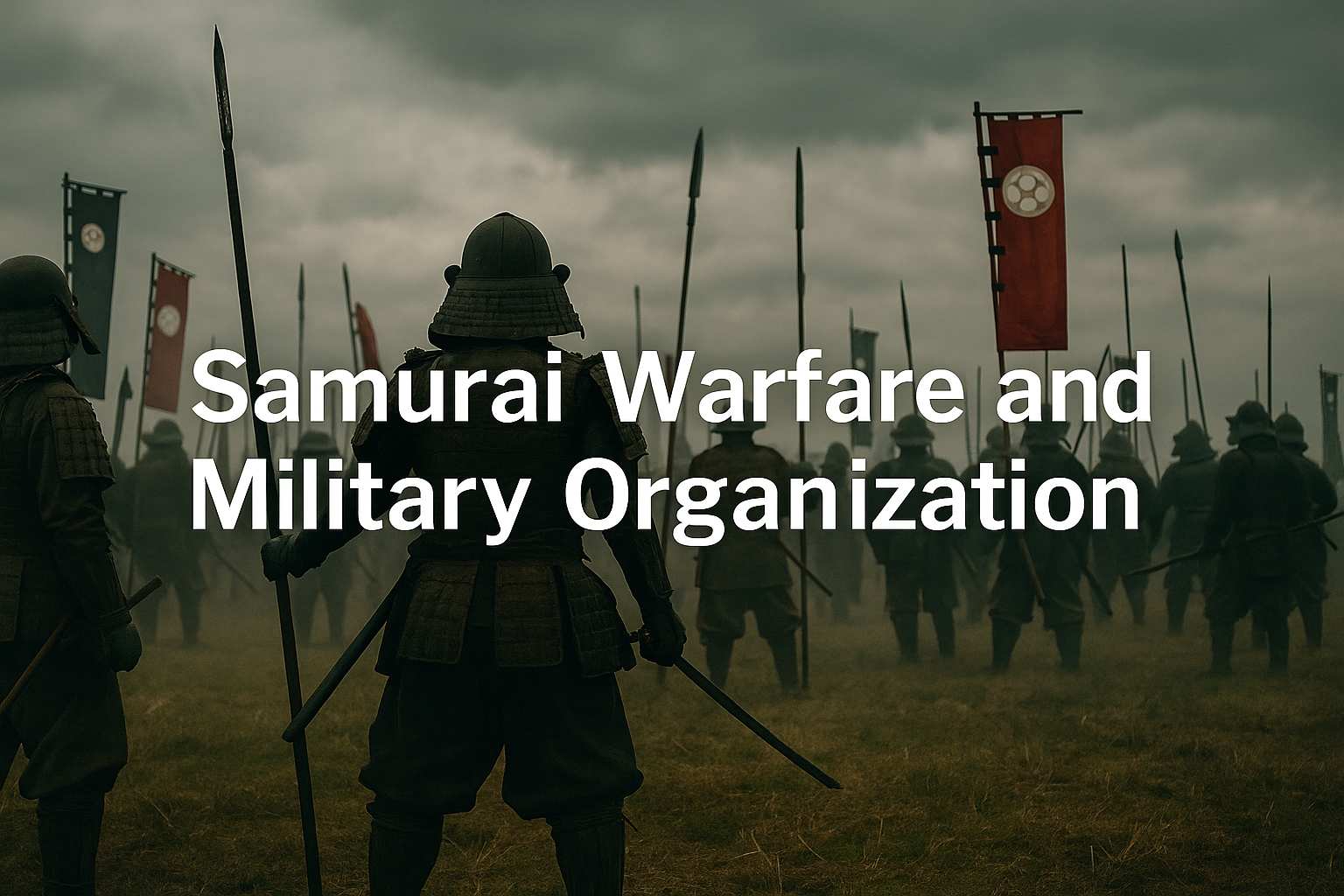
Feudal armies followed a clear hierarchy: Samurai commanders → unit leaders → foot soldiers. Each commander led a mixed force of spearmen, archers, and gunners, trained to fight as coordinated units. This organizational pyramid ensured discipline on the battlefield.
2-1. Unit Composition
A basic unit (called kumi) consisted of about 5–10 men. Multiple units formed a “division” (tai), and several divisions made up an entire army. Warfare was built on collective coordination, not individual strength.
2-2. Feudal Mobilization System
Daimyo lords mobilized their armies through networks of vassals, each bringing their own retainers and farmers-turned-soldiers. This “chain of loyalty” created a vast, decentralized military system that could respond quickly to war.
3. Roles of Spear, Bow, and Gun Units
3-1. Spear Units (Yari-tai)
The spear (yari) was the dominant weapon of the battlefield, favored for its long reach and collective use. Soldiers formed tight lines known as yaribusuma, advancing or defending as one. Under leaders like Oda Nobunaga, these formations became a disciplined defensive wall.
3-2. Archery Units
Archery was once the symbol of samurai virtue — the “Way of the Bow and Horse.” Though gradually replaced by firearms, bow units still played vital roles in castle sieges, ambushes, and mountain warfare, where long-range attacks were essential.
3-3. Firearm Units
After Portuguese traders introduced matchlock guns in 1543, Japan’s tactics changed forever. At the Battle of Nagashino (1575), Oda Nobunaga’s three-line musket formation crushed the Takeda cavalry, proving the power of disciplined volley fire.
4. Castles and Strategy
Feudal castles were not only fortresses but also command centers, supply bases, and political symbols. Their locations took advantage of terrain — mountains, plains, or rivers — to provide both defense and control over regions.
4-1. Fortresses as Command Bases
Castles like Himeji Castle and Osaka Castle were masterpieces of defensive architecture, combining moats, stone walls, and towers. They served as nerve centers for military strategy.
4-2. From War to Peace
After the Tokugawa Shogunate unified Japan, castles lost their military roles and became administrative centers. Yet they remained symbols of samurai order and power, shaping the urban design of castle towns like Himeji and Osaka.
5. The Aesthetics of Strategy and Honor
Even in war, samurai sought balance between strength and virtue. Honor, loyalty, and self-discipline guided their actions, turning warfare into an art form. Battle formations, banners, and armor were designed with aesthetic harmony, reflecting both practicality and beauty.
6. Experience Samurai Tactics in Modern Tokyo
Today, travelers can experience samurai-style combat techniques in Tokyo through realistic training programs. SYDO Inc., operator of the SAMURAI EXPERIENCE in Harajuku, offers interactive sessions in sword fighting and samurai etiquette.
Learn the discipline and teamwork that once defined Japan’s greatest warriors — not on a battlefield, but through a cultural experience designed for today’s travelers.