
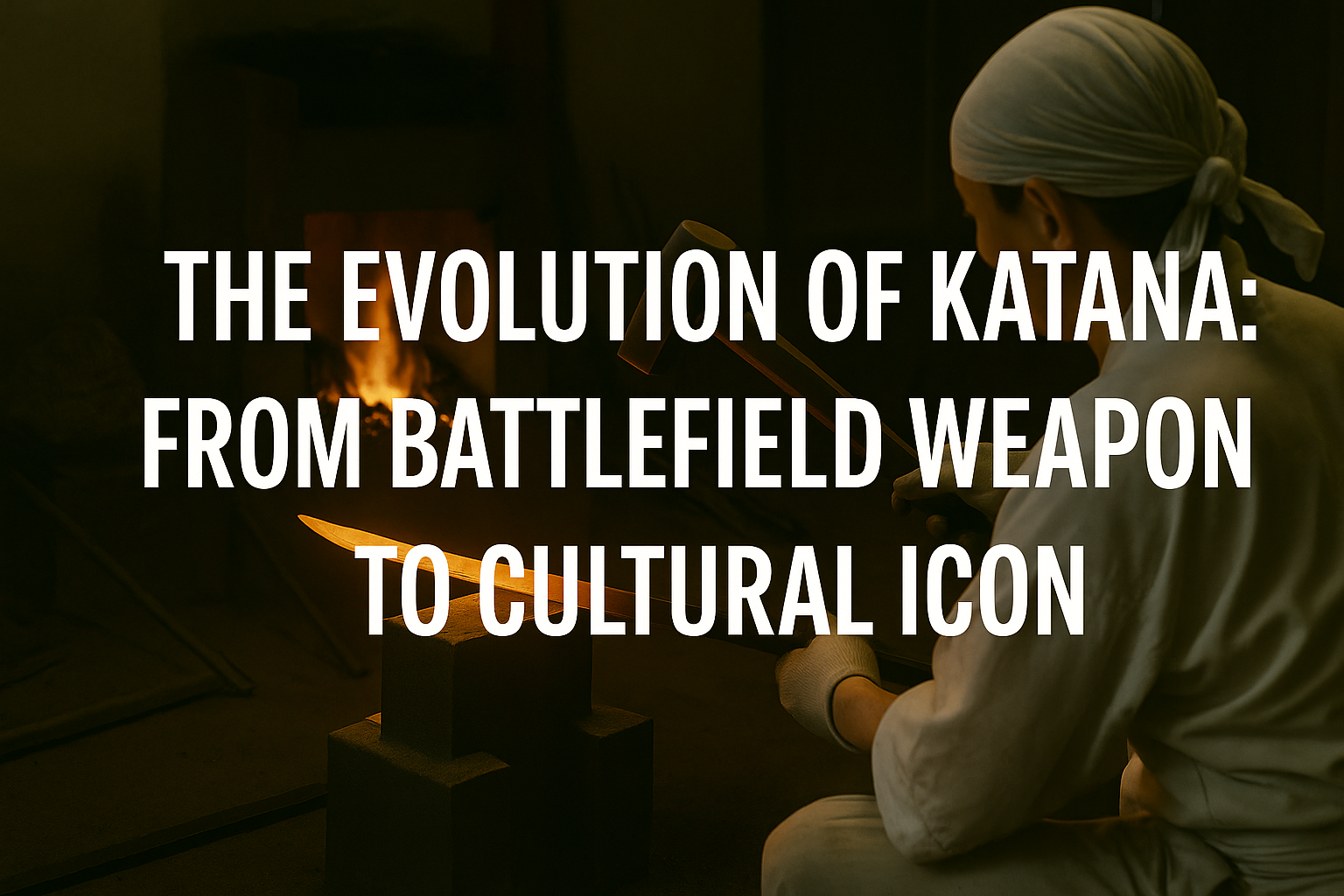
For many travelers, the word katana instantly evokes images of a perfectly curved Japanese sword, glinting in the light like a work of art. But the katana we know today did not appear overnight. It is the result of more than a thousand years of evolution, shaped by changes in warfare, politics, and Japanese society itself.
In this guide, we will explore how Japanese swords transformed from simple battlefield weapons into cultural icons. We will also show you where to see real swords in Tokyo today – and how to actually hold one safely in a samurai experience.
- From Straight Blades to Curved Swords: The Origins of the Katana
- From Tachi to Katana: Changing Battlefields, Changing Swords
- Peace Changes Everything: The Edo Period and the Status Symbol Sword
- Meiji Restoration and the Sword Ban: The End of the Samurai Weapon
- How to “Read” a Katana: Design Features That Tell Its Story
- From Battlefield Weapon to Pop-Culture Icon
- Where to See the Evolution of Katana in Tokyo
- Conclusion: The Katana Continues to Evolve
From Straight Blades to Curved Swords: The Origins of the Katana
Early straight swords and continental influence
In ancient Japan, warriors did not carry the sleek curved blades we associate with samurai. Instead, they used chokutō, straight iron swords influenced by weapons from China and the Korean Peninsula. These early blades were often used as much for ceremony and status as for actual combat.
At this stage, Japanese swords were still relatively simple: straight, sometimes double-edged, and without the pronounced curve that later became the hallmark of the katana.
Horseback warfare and the birth of the curved tachi
From the late Heian period onward, the style of warfare in Japan began to change. Mounted archery battles became more common, and warriors needed a sword that worked efficiently when cutting down at an enemy from horseback.
This is when the tachi appeared. Worn edge-down and hung from the belt, the tachi featured a deep curve that allowed it to slice smoothly through a target when swung from a horse. Its design was optimized for powerful slashing attacks rather than thrusting.
With the arrival of the tachi, the Japanese sword started to resemble the elegant, curved weapon that fascinates travelers today.
From Tachi to Katana: Changing Battlefields, Changing Swords
From open battlefields to close-quarters combat
During the Muromachi and Sengoku periods, warfare spread from open fields to castle interiors, narrow streets, and town environments. Close-quarters combat became more common, and samurai needed a weapon that was easy to draw quickly while fighting on foot.
The answer was the uchigatana, the direct ancestor of the modern katana. Worn thrust through the belt with the edge facing upward, it allowed the swordsman to draw and cut in a single smooth motion. The blade length and curvature were adjusted to be more practical for infantry combat and indoor fighting.
Mass production and masterpieces in the Sengoku era
The age of warring states created a huge demand for weapons. Swordsmiths had to produce large numbers of functional blades for common soldiers, while also crafting exquisite swords for warlords and high-ranking samurai.
This dual demand pushed swordsmithing forward in two directions at once: practical, durable blades for the battlefield, and highly refined weapons that doubled as prestige objects and family treasures. Many of the most famous swords admired today were forged in this turbulent era.
Peace Changes Everything: The Edo Period and the Status Symbol Sword
From weapon to social identity
When the Tokugawa shogunate unified Japan and peace took hold in the early 17th century, large-scale warfare virtually disappeared. Yet the sword remained central to samurai identity.
Instead of using their blades regularly in battle, samurai now wore them as symbols of their class and status. The paired long and short swords known as daishō became a visual badge of the samurai, marking them as members of the warrior elite even in times of peace.
Artistry and detail: swords as complete works of art
In this relatively peaceful era, the artistic aspects of swords flourished. Swordsmiths refined the shape and steel of the blade, while other specialists focused on the external fittings:
- Hamon – the temper line created during quenching, forming beautiful wave-like patterns along the edge.
- Jigane – the surface texture of the steel, revealing layers created by repeated folding and forging.
- Koshirae – the mountings of the sword, including the handle wrapping, tsuba (guard), and lacquered scabbard.
A fine Edo-period sword is not just a weapon; it is a collaborative artwork that combines metallurgy, carpentry, lacquerwork, metal engraving, and more.
Meiji Restoration and the Sword Ban: The End of the Samurai Weapon
The Haitōrei and the crisis for swordsmiths
In the late 19th century, Japan underwent rapid modernization. The government introduced Western-style uniforms and firearms, and in 1876 the Haitōrei edict effectively banned the wearing of swords by most civilians.
For many samurai, losing the right to carry a sword meant losing a key part of their public identity. For swordsmiths and craftspeople, it meant a sudden and severe decline in demand. The sword seemed to be disappearing from everyday life.
Rebirth as art objects and cultural heritage
Yet the story did not end there. Collectors, historians, and artisans began to view Japanese swords as works of art and cultural heritage worth preserving. Organizations dedicated to the preservation and study of swords were established, eventually leading to institutions such as The Japanese Sword Museum in Tokyo, which conserves important blades and promotes appreciation of sword craftsmanship.:contentReference[oaicite:3]{index=3}
Thanks to these efforts, many masterpieces survived into the present day, and new generations of swordsmiths continue the tradition under Japan’s system for preserving important cultural properties.
How to “Read” a Katana: Design Features That Tell Its Story
Overall shape: length, curvature, and profile
The easiest way to understand a sword’s background is to look at its overall silhouette, or sugata. A long blade with deep curvature often points to an earlier era of mounted combat, while a slightly shorter, more moderate curve suggests a weapon optimized for fighting on foot in tighter spaces.
Hamon and jigane: the swordsmith’s signature
At first glance, many swords might look similar behind the glass of a museum display. But if you look closely, you will notice delicate patterns:
- Hamon – the bright line along the edge, whose shape can resemble waves, small teeth, or mist.
- Jigane – the subtle grain in the steel, created by folding and welding the metal many times.
These features are like a fingerprint. They reveal the techniques and personal style of the swordsmith, as well as the traditions of the school and region in which the blade was forged.
Koshirae: fittings that express the owner’s taste
The blade is only half of the story. The mountings – handle, guard, and scabbard – reveal the owner’s personality, status, and taste. A warlord might commission a bold, heavily decorated koshirae, while a city samurai or wealthy merchant might prefer something more understated and elegant.
When you visit a museum, pay attention not only to the blade but also to the fittings. They tell you who might have worn the sword and in what kind of environment.
From Battlefield Weapon to Pop-Culture Icon
Today, many visitors first encounter the katana not in a museum but in anime, manga, video games, and movies. These stories often exaggerate the sword’s power, presenting it as a near-magical weapon capable of cutting through anything.
Of course, real swords have limits. Yet pop culture has played an important role in spreading interest in Japanese swords worldwide. For many travelers, a childhood fascination with katana eventually becomes a real journey to Japan to see and learn about genuine blades.
Where to See the Evolution of Katana in Tokyo
The Japanese Sword Museum (Ryogoku)
The Japanese Sword Museum in Ryogoku is dedicated entirely to Japanese swords. Its rotating exhibitions showcase blades from different eras, along with fittings and historical documents. Here you can literally walk through centuries of sword evolution in a single visit.:contentReference[oaicite:4]{index=4}
Tokyo National Museum (Ueno)
At Tokyo National Museum in Ueno, you can see some of Japan’s most important swords, including national treasures, alongside armor, paintings, and other artifacts related to the samurai class. Special exhibitions often highlight famous blades and their makers.:contentReference[oaicite:5]{index=5}
Feel the weight of a sword in your own hands: Samurai experience in Harajuku
Museums are perfect for studying the history and beauty of katana. But if you want to understand how a sword feels in your hands – its weight, balance, and movement – a hands-on experience is invaluable.
In Tokyo’s Harajuku district, you can join a Samurai Experience sword training session. Using safe practice swords under the guidance of professional instructors, you will learn basic stances, cuts, and etiquette derived from traditional sword arts and samurai stage combat.
Combining a museum visit with an interactive samurai experience will give you a much deeper appreciation of how the katana evolved from a practical weapon into one of Japan’s most enduring cultural icons.
Conclusion: The Katana Continues to Evolve
The story of the katana is far from static. It has moved from straight blades to curved tachi, from battlefield katana to Edo-period status symbols, from Meiji-era art objects to modern pop-culture legends.
On your next trip to Tokyo, consider tracing this evolution for yourself: study masterpieces in museums, observe the details of blades and fittings, and then step into a dojo-like space in Harajuku to feel the motion of a sword in your own hands. In doing so, you will experience not just a weapon, but a living symbol of Japanese history and imagination.